From Patchwork to Platform: Why SASE Beats a Stack of Point Solutions
 Cybergen InsightsCREST-certified security team
|
|
8 min read
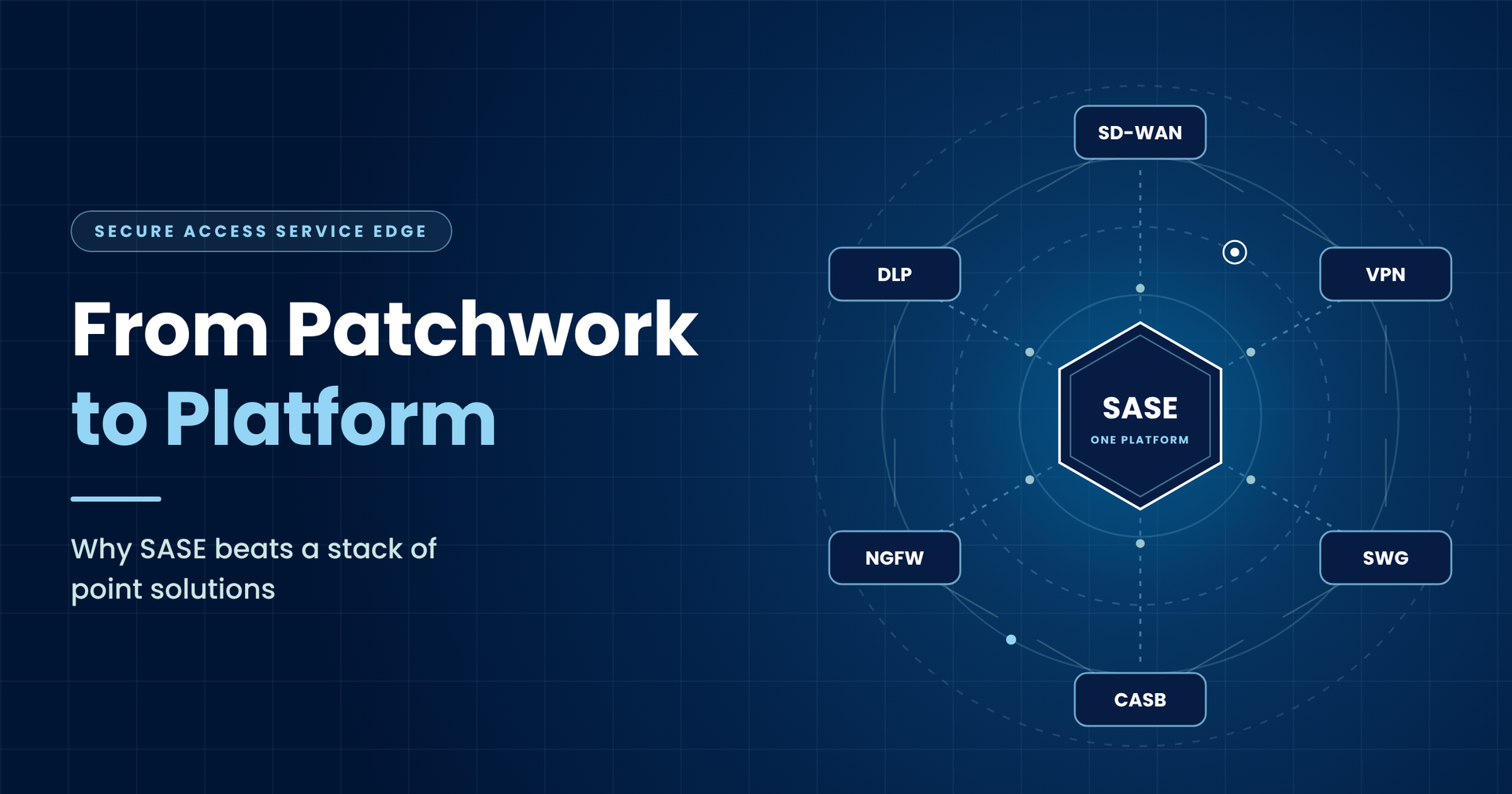
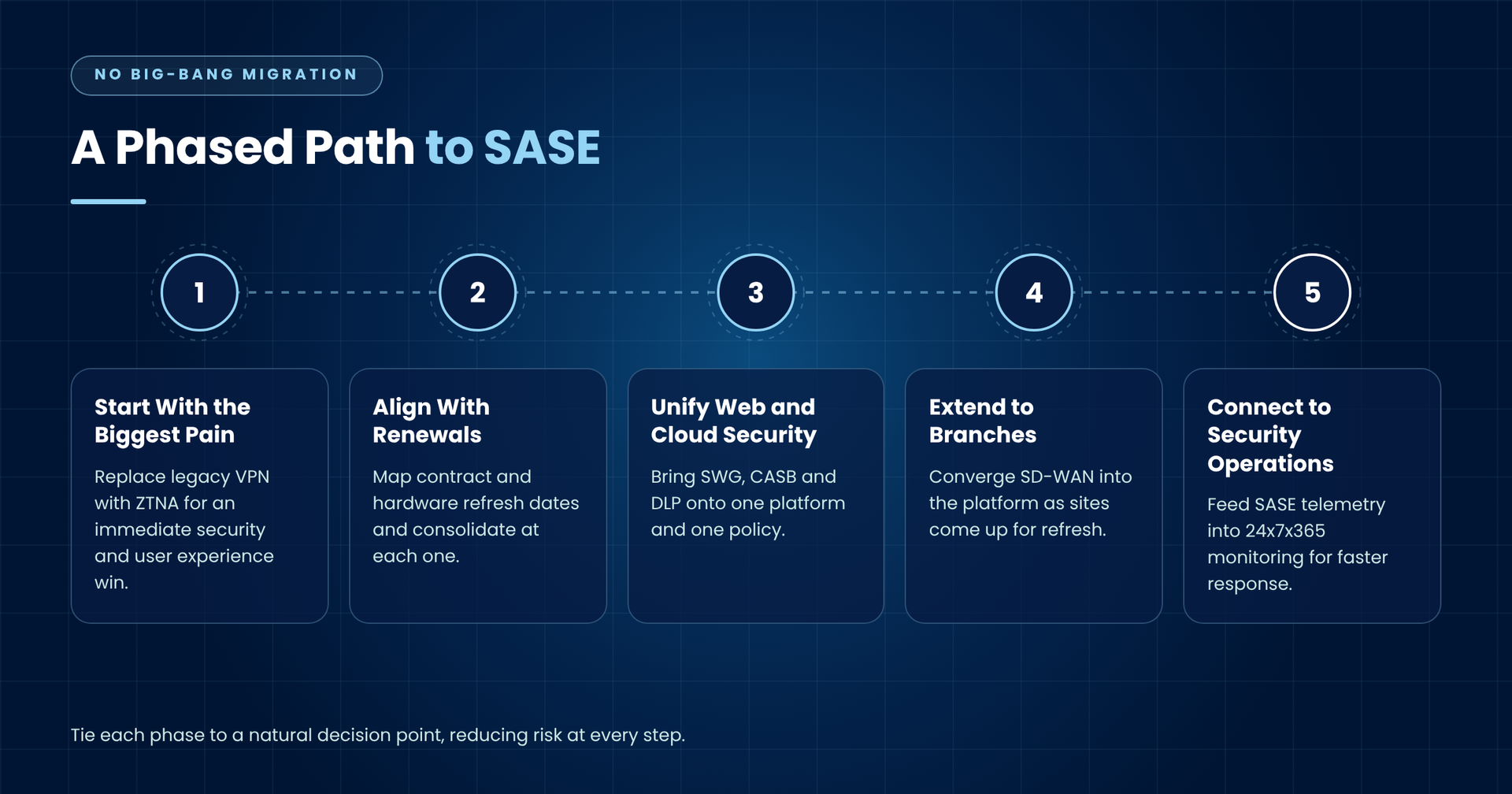
Walk into most organisations' network cupboard (or open their cloud console) and you'll find the same story told in hardware and licences. An SD-WAN appliance at every branch. A VPN concentrator that was sized for a handful of remote workers and now carries hundreds. A secure web gateway from one vendor, a cloud access security broker from another, a firewall estate from a third, and a data loss prevention tool that nobody is quite sure is configured properly.
Each of those products was bought for a good reason. Together, they've become one of the biggest sources of cost, complexity and risk in the modern business. Secure Access Service Edge (SASE) exists to fix that.
How We Ended Up With So Many Boxes
Traditional networks were built around a simple idea: the data centre was the centre of the world. Users sat in offices, applications sat in the server room, and security sat at the perimeter between the two.
Then everything moved. Applications went to SaaS and public cloud. Users went home, to client sites and to coffee shops. Branches started connecting directly to the internet rather than through head office.
The industry's response was to bolt on a new product for every new problem:
- SD-WAN to make branch connectivity cheaper and smarter
- VPNs to bring remote users back inside the perimeter
- Secure web gateways to filter internet traffic
- CASBs to get visibility of cloud applications
- Next-generation firewalls at every site that needed protecting
- DLP tools to stop sensitive data walking out of the door
Every one of these is a point solution. Each solves one problem well, in isolation. None of them were designed to work as a whole.
The Hidden Cost of Point Solutions
The price on the invoice is only the start. The real cost of a patchwork stack shows up in day-to-day operations.
Too many consoles. Your team logs into five or six management interfaces to understand a single incident. Every tool has its own policy language, its own logs and its own update cycle.
Policy drift. When the same rule has to be written separately in the firewall, the web gateway and the VPN, those rules gradually fall out of step. Gaps appear between tools, and attackers live in those gaps.
Poor user experience. Backhauling remote and branch traffic through a central VPN or data centre to be inspected adds latency to every cloud application. Users notice, and they find workarounds.
VPNs as an attack surface. Internet-facing VPN appliances have been among the most heavily targeted devices in recent years. Worse, a traditional VPN typically grants broad network access once a user is connected, so one stolen credential can open far more than it should.
Scaling pain. Opening a new office, onboarding an acquisition or adding a few hundred contractors means buying, shipping and configuring more hardware. Capacity planning becomes guesswork, and hardware refresh cycles never quite line up.
Fragmented visibility. With data spread across separate tools, your security operations team is stitching together evidence from multiple sources at exactly the moment speed matters most.
What SASE Actually Is
SASE brings networking and security together into a single, cloud-delivered service. Instead of sending traffic to security, SASE brings security to the traffic, inspecting it at a nearby cloud point of presence wherever the user or site happens to be.
It combines two halves:
- The network side: SD-WAN capabilities that route traffic intelligently and efficiently between sites, users and applications.
- The security side, often called Security Service Edge (SSE): secure web gateway, CASB, Zero Trust Network Access (ZTNA), firewall as a service and DLP, all running as one platform.
Crucially, access decisions are based on identity and context (who the user is, what device they're on, what they're trying to reach) rather than on which network they happen to be connected to. That is Zero Trust in practice, not just in a strategy document.
What SASE Isn't
SASE has become one of the most overused labels in the industry, and plenty of products now carry it without delivering what it promises. Knowing what doesn't qualify is the quickest way to judge what does.
SD-WAN on its own isn't SASE. Smart routing and the ability to run over any underlying connection are genuinely valuable, and they form part of SASE. But SD-WAN covers only the networking half, and many SD-WAN deployments offer little or nothing for mobile and remote users.
Cloud-delivered security on its own isn't SASE. A capable cloud firewall, web gateway or intrusion prevention service covers part of the security half. It does nothing for routing, WAN optimisation or performance across a global footprint, so even several of these bundled together fall short.
A collection of separately sourced products isn't SASE. You can buy a tool for every box on the SASE feature list and still end up with the patchwork described above: separate consoles, separate policies, integration work and rising costs. Handing that patchwork to a service provider to run moves the complexity, but it doesn't remove it.
Virtual appliances aren't SASE. Running security software as virtual machines on an edge device saves rack space, but every instance still has to be deployed, patched, upgraded and integrated. The silos remain. Genuine SASE removes the appliance model altogether, delivering functions from a shared, cloud-native platform that the provider maintains for every customer.
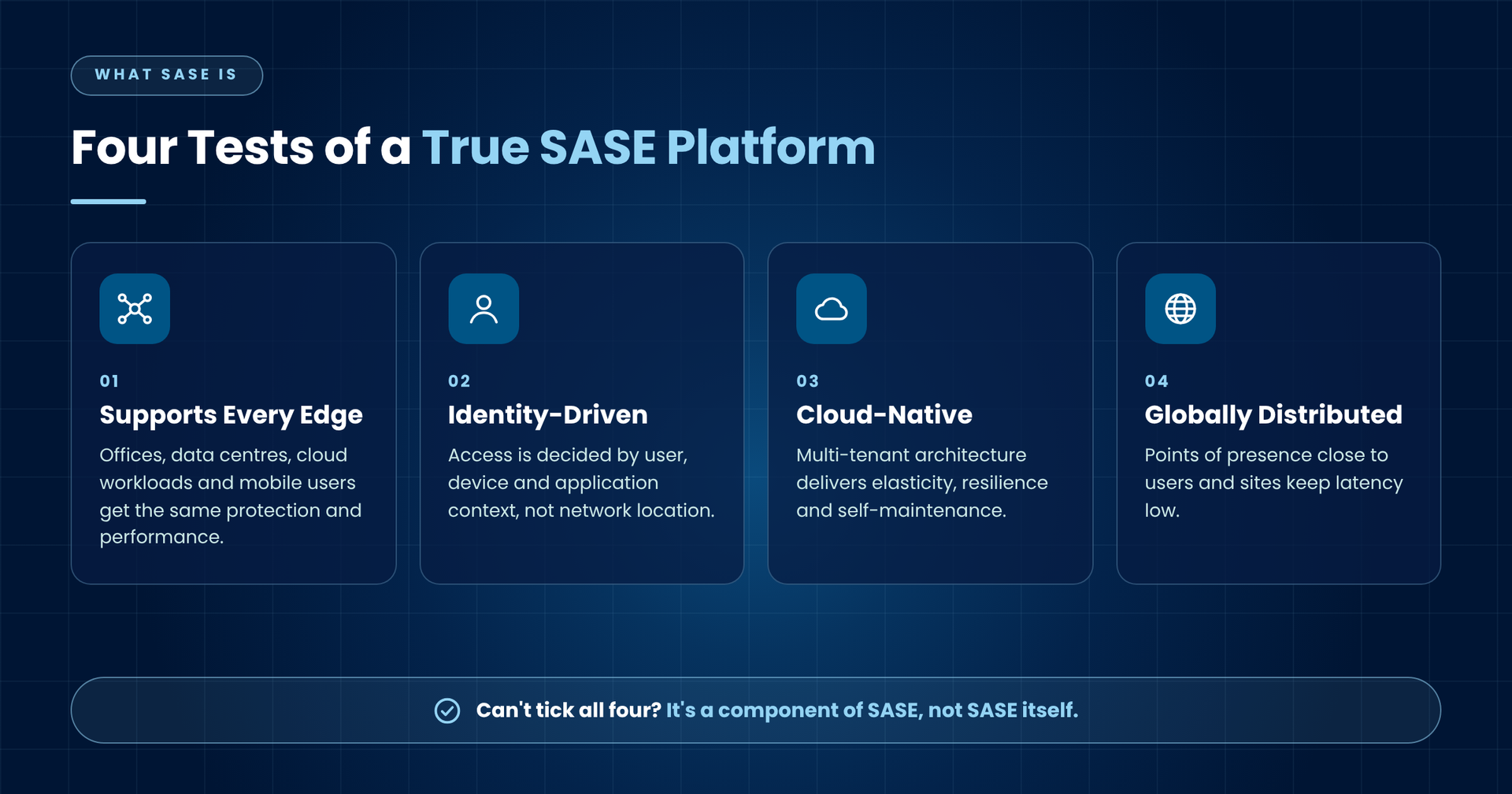
So what should you look for? A true SASE platform has four characteristics:
- It supports every edge. Offices, data centres, cloud workloads and mobile users all get the same protection and performance, wherever they are.
- It's identity-driven. Every user, device and application is identified, and access decisions are made on that context rather than on network location.
- It's cloud-native. A multi-tenant architecture delivers the elasticity, resilience and self-maintenance that appliances can't.
- It's globally distributed. Points of presence close to your users and sites keep latency low, so security never comes at the cost of performance.
If a solution can't tick all four, it's a component of SASE, not SASE itself.
Consolidation: One Policy, One Console, One Data Set
The most immediate benefit of SASE is consolidation.
With a single platform, a policy is written once and enforced everywhere: in the office, at home, at a branch, or on a mobile device in an airport. There is one console for your team to learn, one set of logs to search and one vendor relationship to manage.
That consolidation pays off in several ways:
- Fewer gaps. When web filtering, application access and data protection share one policy engine, there are no seams between products for threats to slip through.
- Faster investigations. A single data set means your analysts can follow a user, device or file across the whole environment without jumping between tools.
- Lower operating cost. Fewer appliances to patch, fewer contracts to renew and fewer specialist skills required for each individual product.
- Simpler compliance. Consistent controls and centralised logging make it far easier to evidence what you're doing to auditors and regulators.
Flexibility: Security That Moves With Your Business
Point solutions are tied to places. SASE is tied to people and data, which is what makes it so flexible.
- New sites go live faster. A branch needs an internet connection and a lightweight edge device, not a rack of security appliances.
- Remote work becomes the default, not the exception. Users connect securely from anywhere, straight to the applications they're authorised to use, without hairpinning through head office.
- Mergers and acquisitions get easier. Bringing a new organisation under your security policy becomes a configuration task rather than an infrastructure project.
- Capacity scales with you. Subscription models are typically based on users or locations, so you grow (or shrink) without forklift upgrades.
- New capabilities arrive as updates. As threats evolve, including the growing need to govern how staff use AI tools, new protections are delivered through the cloud platform rather than through another product purchase.
The Market Is Moving This Way
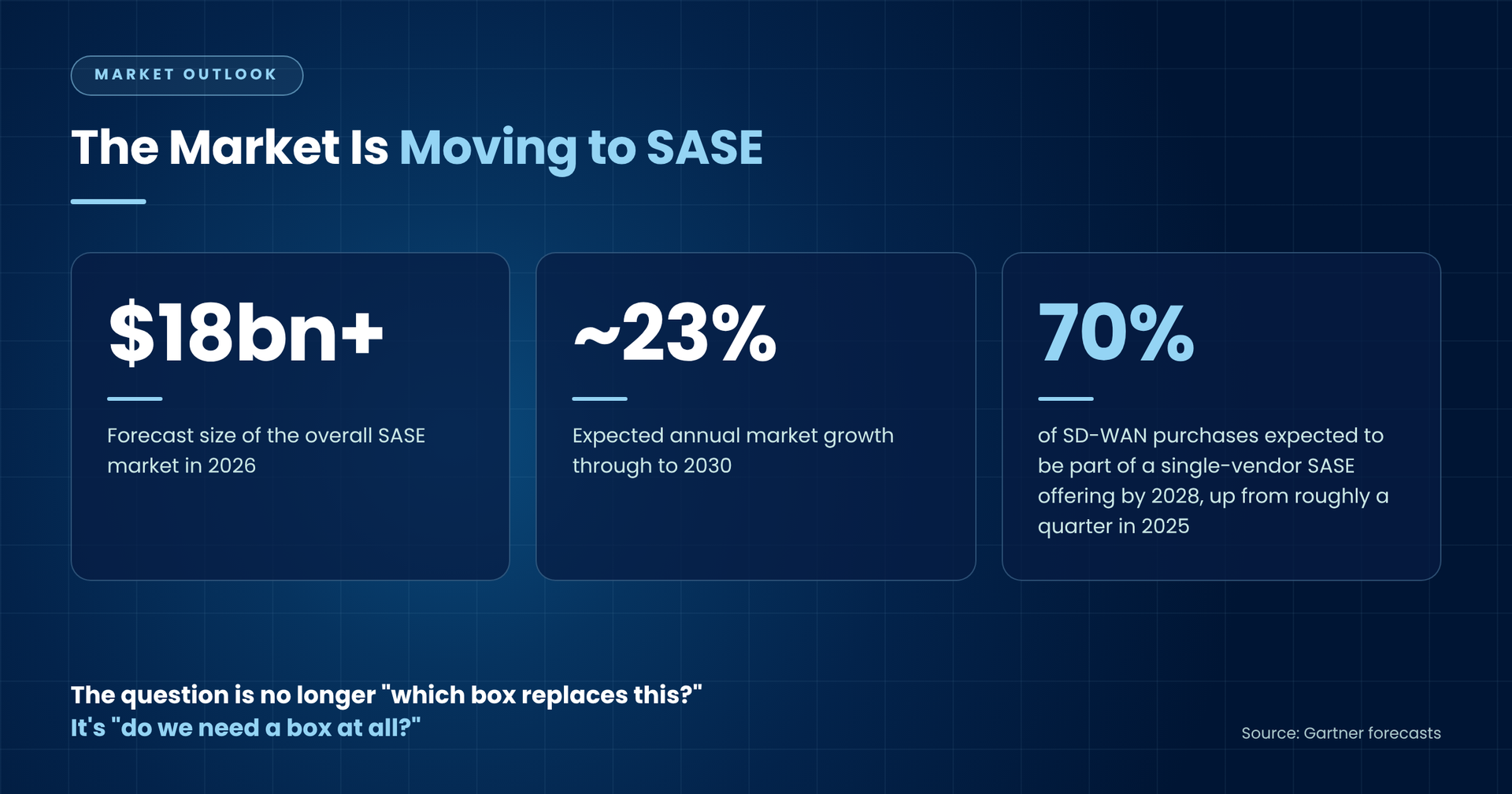
This isn't a niche trend. Gartner expects the overall SASE market to exceed $18 billion in 2026, growing at around 23% a year through to 2030. It also predicts that by 2028, 70% of SD-WAN purchases will be part of a single-vendor SASE offering, up from roughly a quarter in 2025.
In other words, the next time your SD-WAN, VPN or firewall contracts come up for renewal, the question won't just be "which box do we replace this with?" It will be "do we need a box at all?"
Making the Move Without Ripping Everything Out
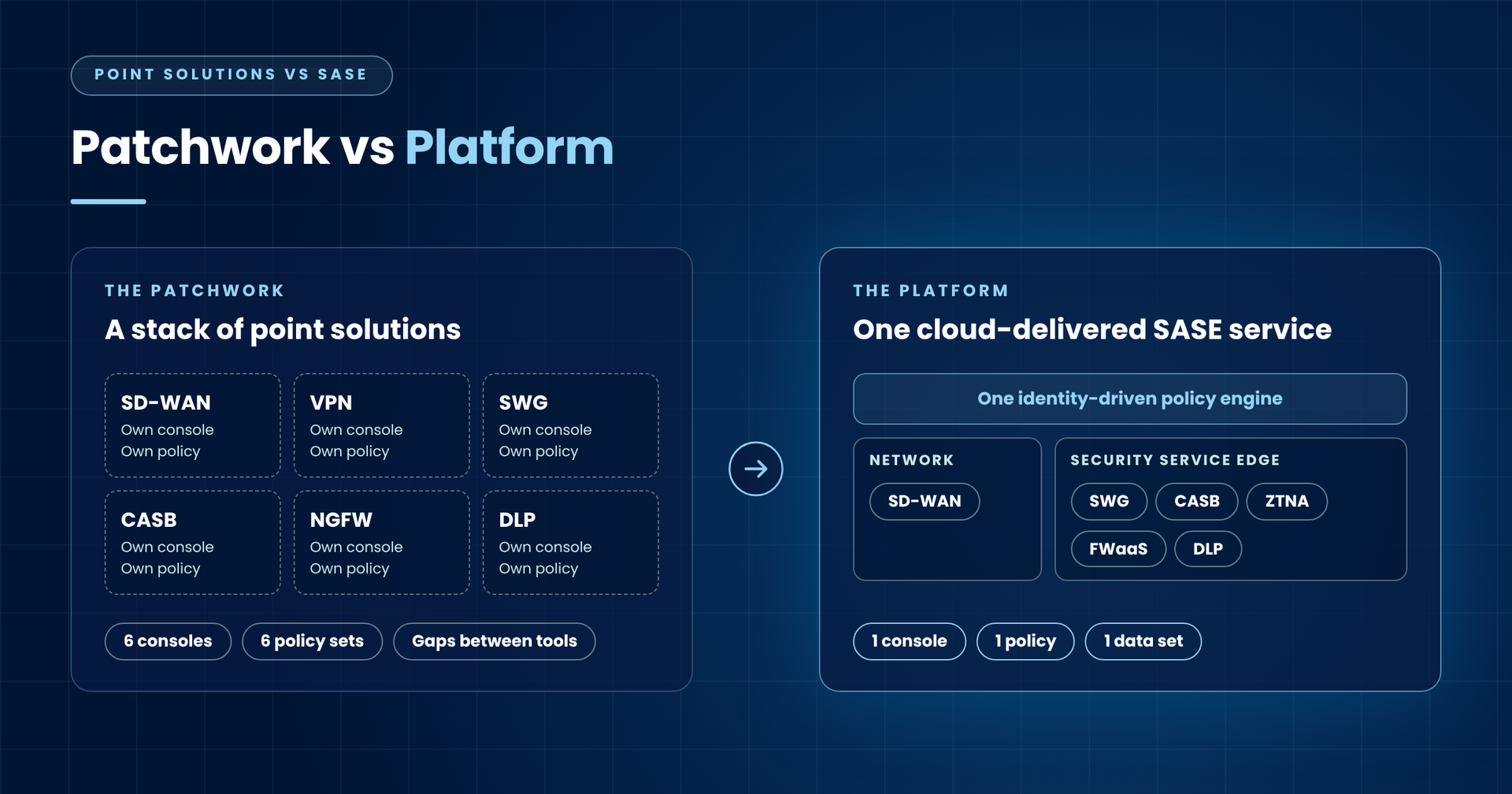
Adopting SASE doesn't have to mean a big-bang migration. The most successful programmes we see are phased and tied to natural decision points:
- Start with the biggest pain point. For many organisations that's replacing legacy VPN with ZTNA, which delivers an immediate security and user experience improvement.
- Align with renewal dates. Map out when each point solution contract or hardware refresh is due and use those moments to consolidate.
- Bring web and cloud security together. Move secure web gateway, CASB and DLP onto the same platform so one policy governs internet, SaaS and data.
- Extend to branches. Converge SD-WAN into the platform as sites come up for refresh.
- Connect it to your security operations. SASE generates rich telemetry. Feeding it into round-the-clock monitoring turns visibility into faster detection and response.
It's also worth deciding early whether a single-vendor platform or a carefully integrated dual-vendor approach best fits your existing estate. There's no universal answer, and the right choice depends on your current investments, your network footprint and your team.
How Cybergen Can Help
Cybergen's specialists help organisations move from a patchwork of point solutions to a SASE architecture that fits how they actually work. We start by understanding your current estate, your users and your renewal timelines, then design a phased roadmap that reduces risk at every step.
We help organisations implement SASE using leading vendor tooling, delivering the full journey: assessment, design, deployment and ongoing management.
Ready to retire the patchwork? Get in touch with the Cybergen team to book a SASE readiness conversation and find out where consolidation could save you cost, complexity and risk.
CREST-certified consultants with over 100 years of combined experience in threat intelligence, penetration testing, MDR and compliance.